A configurator that invites you to design a vehicle it cannot sell you. We found the mental-model break, then proved the fix.
Rivian disrupted the category in 2021 with high-tech EVs and a customer-service reputation to match. That reputation sets the expectation: buyers assume the digital experience will be as considered as the vehicle.
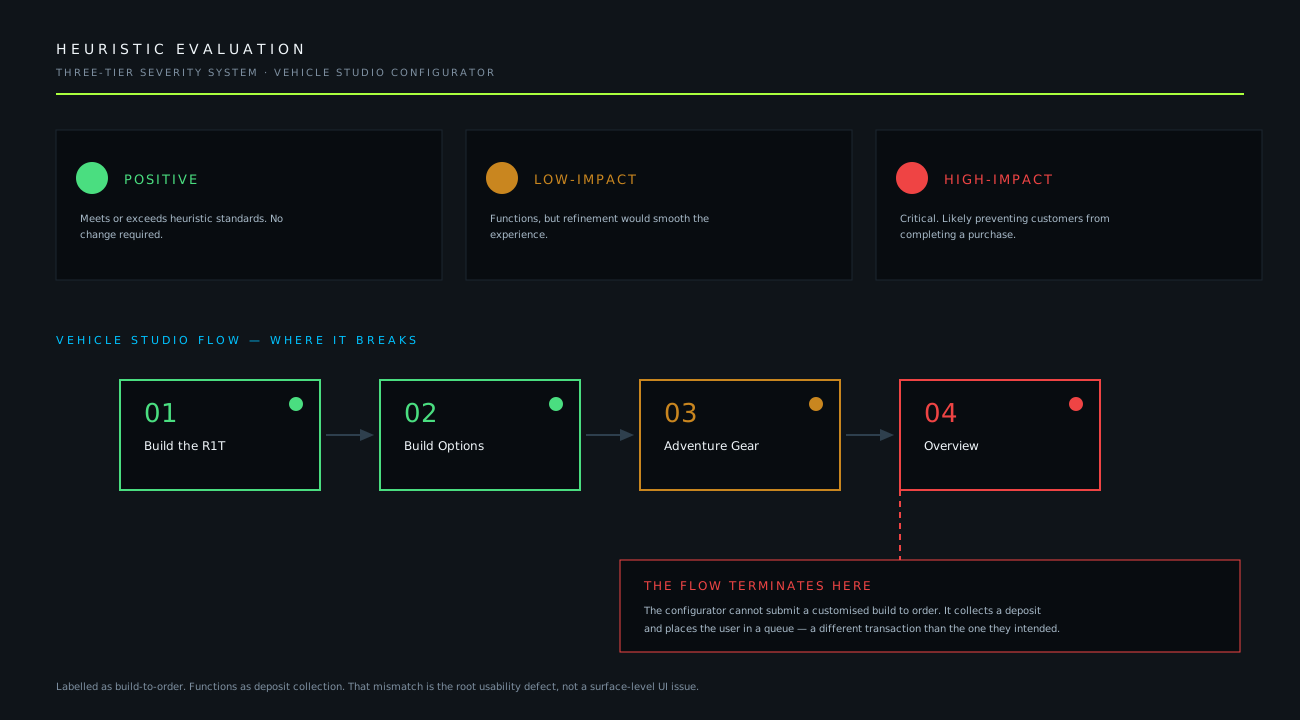
It isn't. The Vehicle Studio configurator is presented as a build-to-order tool, but it cannot submit a customised configuration. It collects a deposit and places the buyer in a queue — a different transaction than the one they believe they are completing.
We were engaged to find the usability failures blocking the order-to-cart journey, benchmark them against the competitive set, and recommend what to change first.
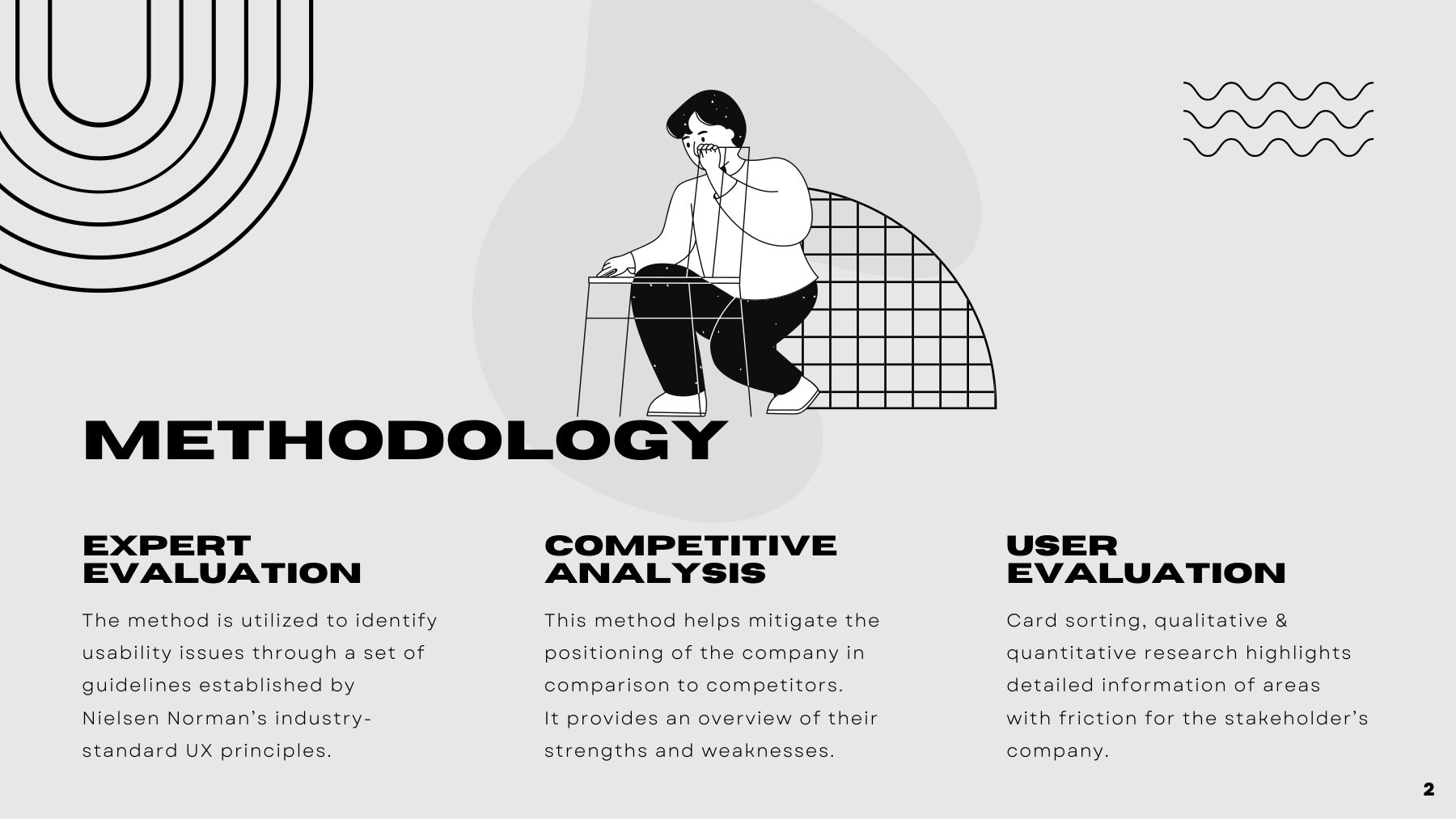
We ran expert, competitive, and user evaluation in sequence, each designed to either confirm or overturn the one before it.
Heuristic evaluation against Nielsen Norman principles, scored on a three-tier severity system.
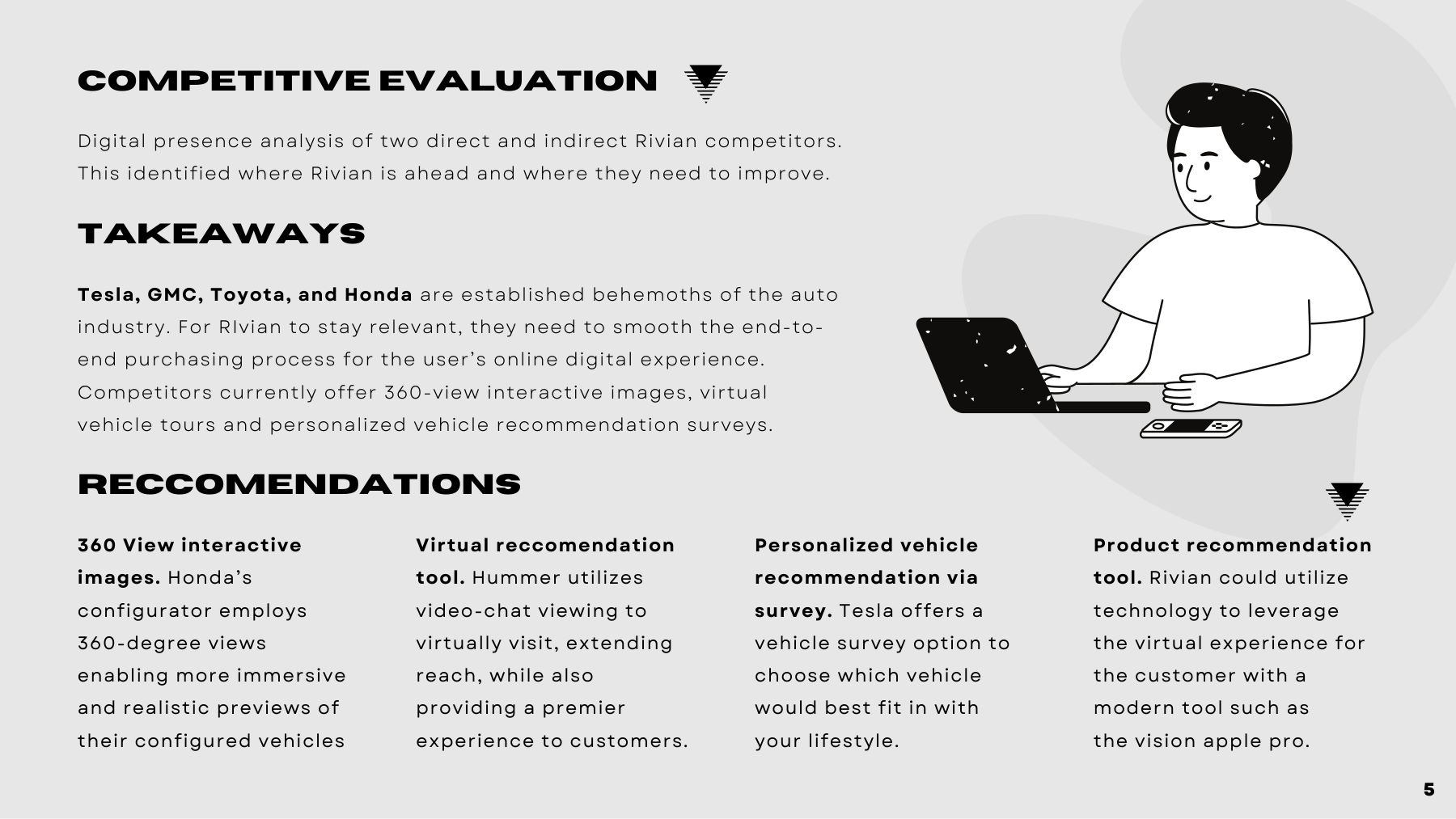
Digital presence analysis across two direct and two indirect competitors to locate parity gaps.
Card sorting, then qualitative usability testing, then quantitative validation of the same flows.
Prototype A/B testing against the friction identified, measured on task success rate.
The configurator reaches the overview screen and stops. There is no path from a completed build to an order — the user has visualised a vehicle the system cannot sell them.
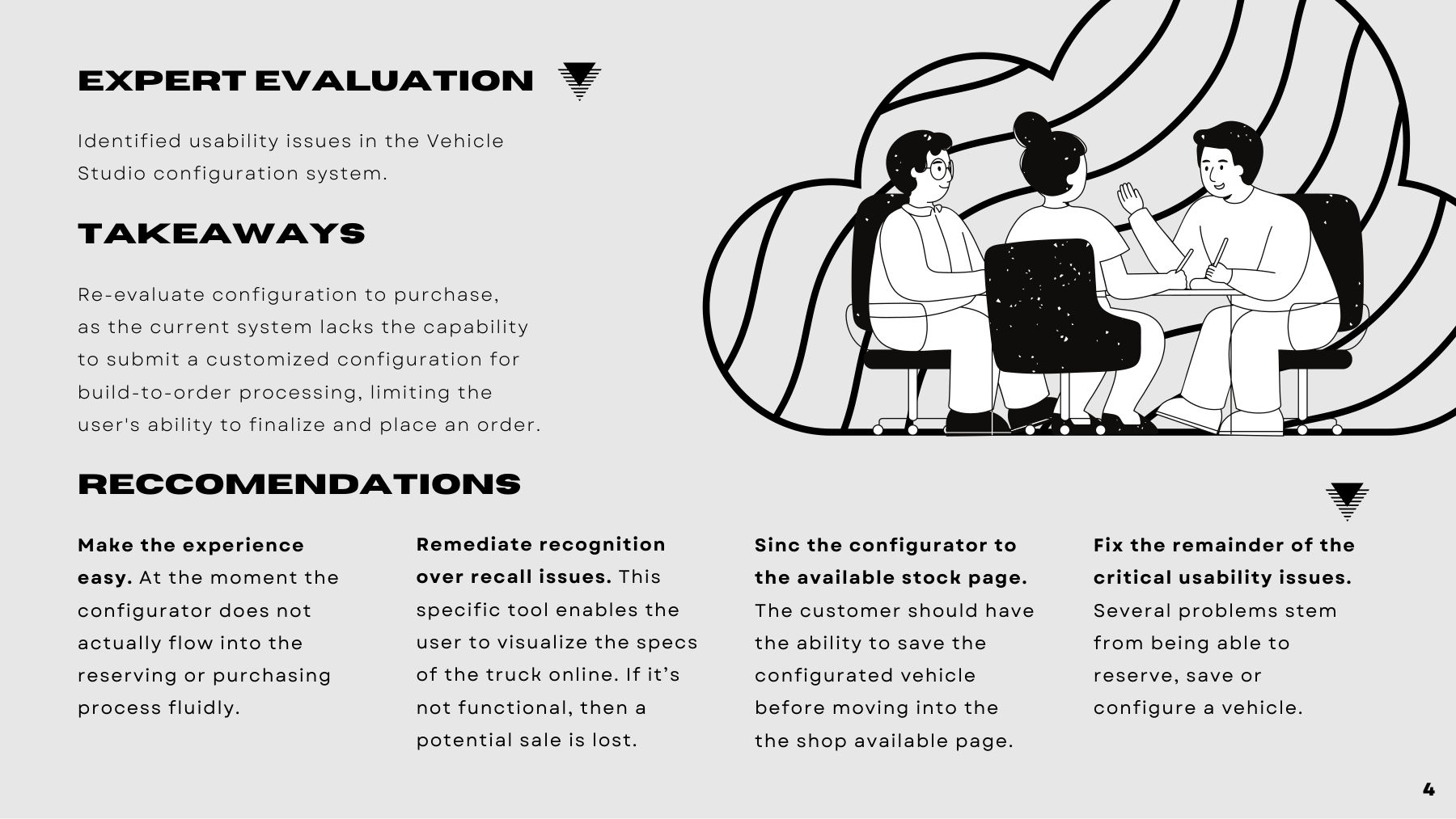
The system lacks the capability to submit a customised configuration for build-to-order processing. The user can specify a vehicle in full detail and still has no mechanism to finalise and place that order.
The configurator exists to let buyers visualise specifications. When it does not carry those specifications into the purchase path, the user is asked to remember their build rather than see it — and a potential sale is lost at precisely that seam.
A buyer should be able to save a configured vehicle before moving to the shop-available page. Without that bridge, the two halves of the purchase operate as unconnected products.
Several remaining issues trace to the same root: the three actions a buyer needs are not cleanly separated, so completing one appears to forfeit another.
Against Tesla, Toyota, Honda, and GMC, Rivian scores highest on interface quality and lowest on commercial conversion. The deficit is not craft — it's that competitors already ship capabilities Rivian doesn't.
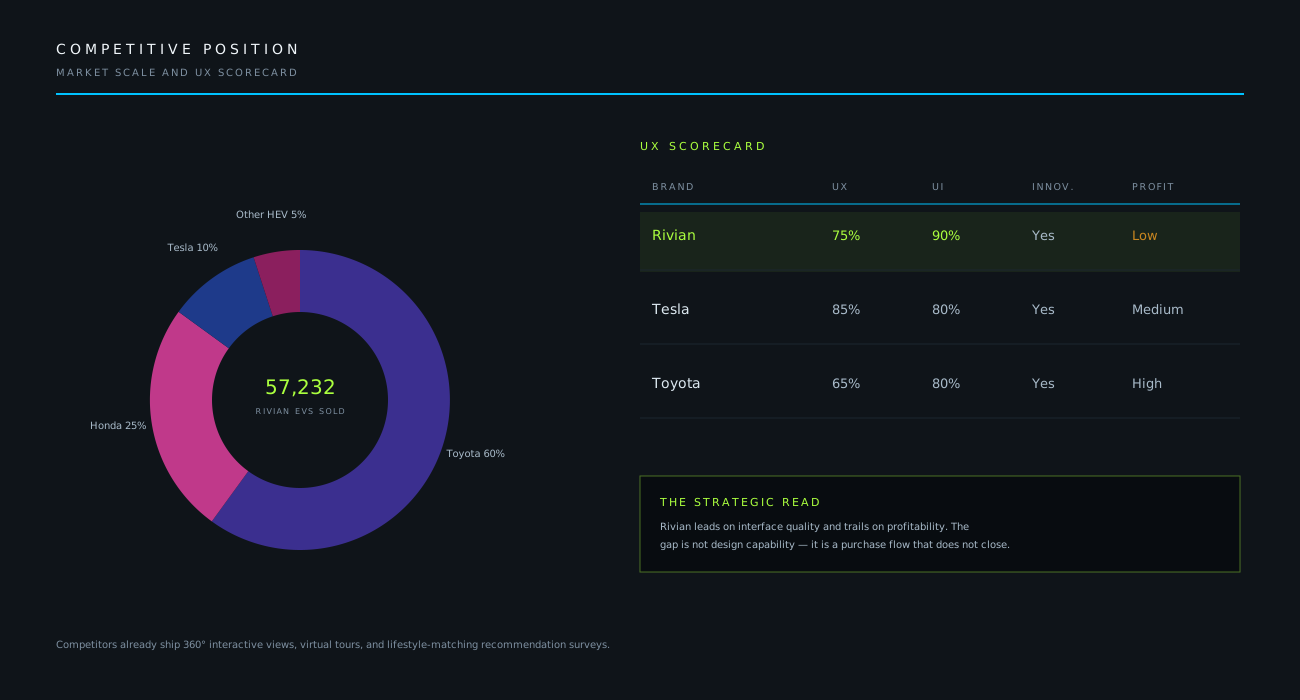
Honda's configurator uses full 360-degree rendering, giving a materially more realistic preview of a configured vehicle than Rivian's current static presentation.
Hummer offers live video-chat walkthroughs — extending reach beyond showroom geography while reading as a premium service rather than a cost-saving one.
Tesla runs a survey that matches a buyer to a vehicle. Rivian asks the buyer to already know which model and configuration they want.
Rivian's positioning gives it licence competitors lack — AR tours, 360° rendering, even loaned Apple Vision Pro viewing would read as on-brand rather than gimmick.
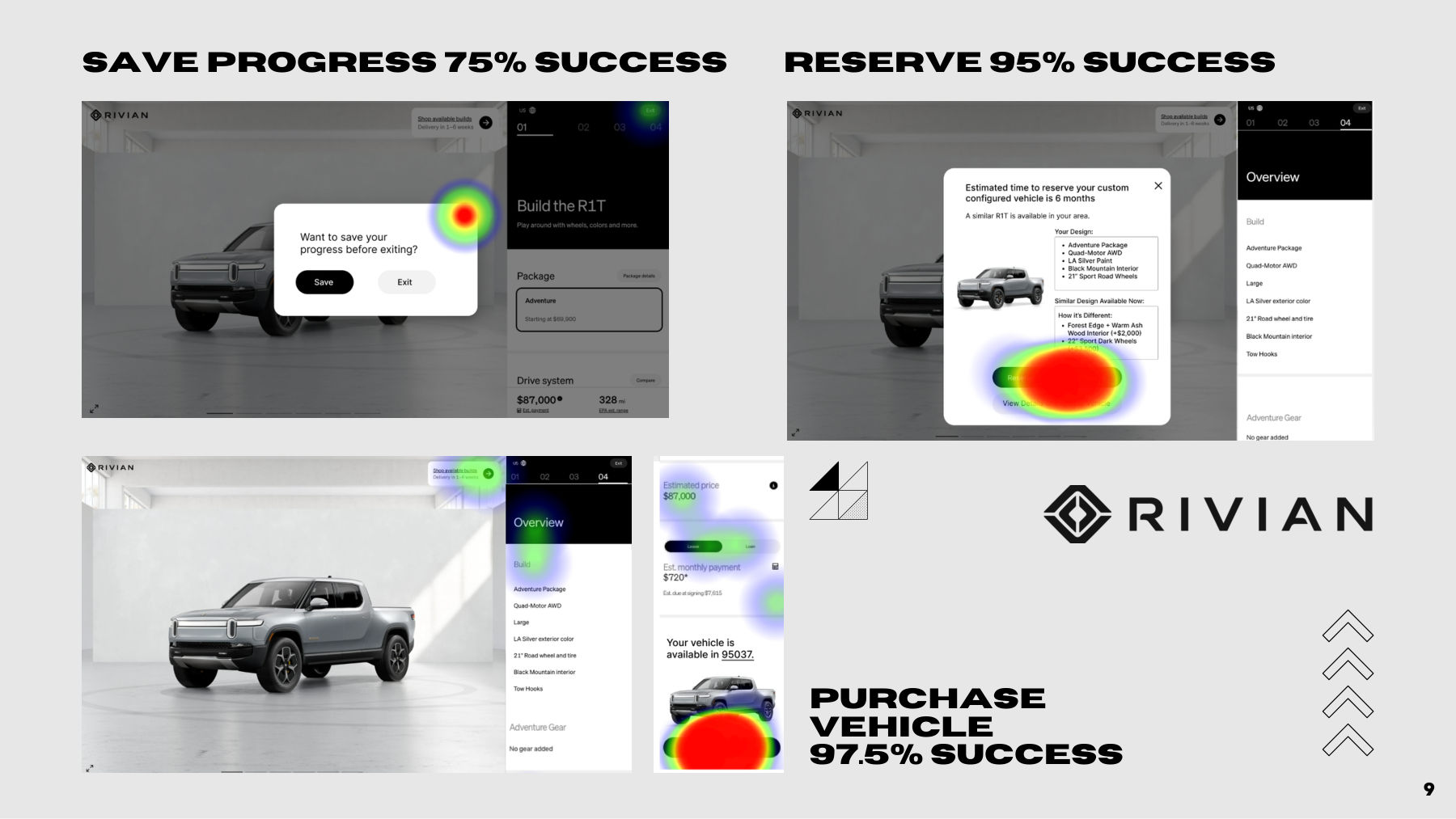
Artifacts from the deliverable: the three-evaluation methodology, expert and competitive findings, and the heatmap results that validated each task flow after iteration.
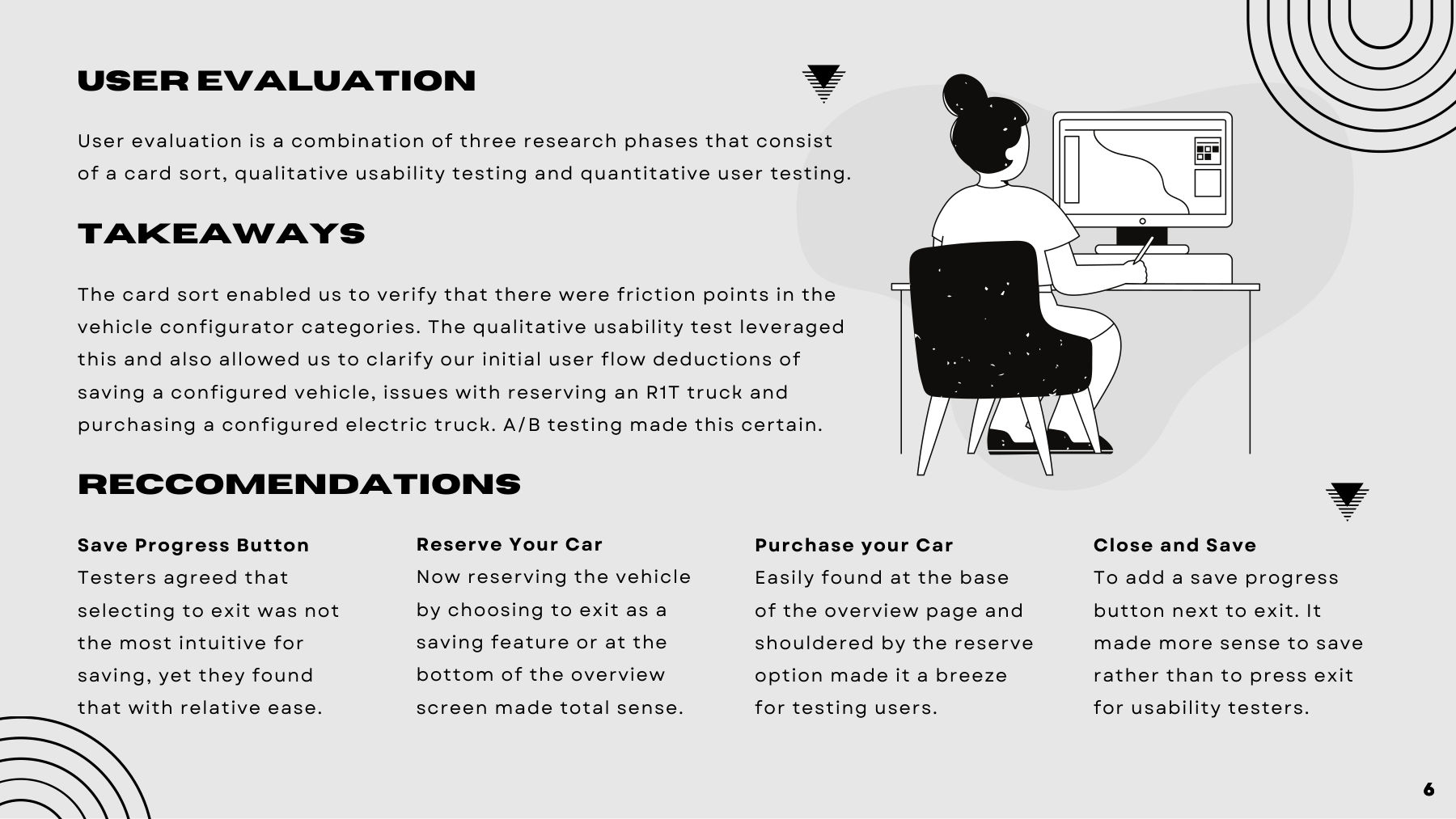
Card sorting showed low agreement on how the four configurator categories — Build the R1T, Build Options, Adventure Gear, Overview — should be organised. Qualitative testing confirmed the same three friction points, and quantitative testing validated them.
Three changes went into the prototype: a save-progress prompt beside exit, reserve surfaced at the overview, and purchase placed alongside reserve rather than behind a separate flow.
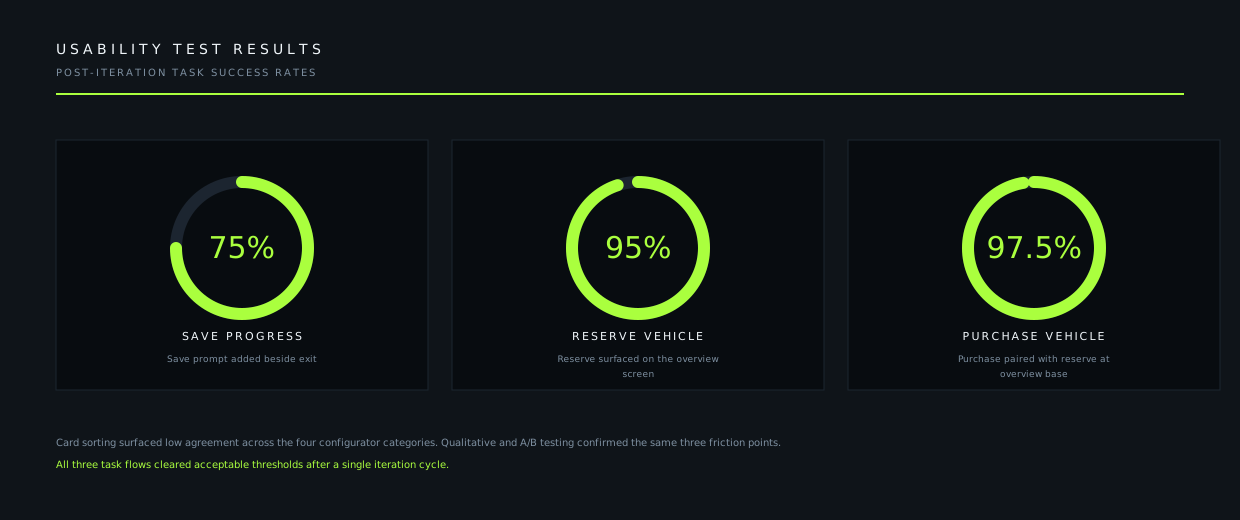
Testers agreed that exiting was not an intuitive way to save. Adding an explicit save prompt beside exit resolved it, though this remains the weakest of the three flows and the first candidate for further iteration.
Offering reservation both on exit and at the base of the overview screen matched how testers expected the decision to work.
Placing purchase at the base of the overview, shouldered by the reserve option, made completion straightforward for nearly every tester.
The configurator break, resolved. Step through the four changes that took purchase-task completion from a dead end to 97.5%. Tap the right-hand screen to advance.
Resolve the mental model first. Either the configurator becomes genuinely build-to-order, or the interface states plainly that it secures a queue position rather than a specified vehicle. A disclaimer manages expectations; a full mental-model overhaul fixes the business problem.
Then close the parity gaps. 360° rendering, virtual tours, and a lifestyle-matching recommendation tool are table stakes in this set — and all three sit naturally within Rivian's brand permission.
Ozzie Feerman — UX Strategist & Researcher. Led the engagement end to end: heuristic evaluation, competitive analysis, research design, usability testing, synthesis, and the final executive recommendation.
Collaborators: Nick, Valerie, and Deaven supported testing sessions and evaluation review.