An entire body of knowledge existed, taught by people willing to teach it. No route connected the two. We mapped the category and designed the missing layer.
 Mentorship Directory — High Fidelityimages/hifi-mentorship.png
Natural building — cob, superadobe, straw bale, rammed earth — is among the oldest construction knowledge in existence, and it is actively practised today by people who want to pass it on.
Yet anyone trying to learn it hits the same wall: scattered video, region-agnostic books, a handful of hard-to-find schools, and mentorship that is effectively invisible unless you already know someone. The knowledge is not missing. The route to it is.
This began as a self-initiated Workflow Labs project — our internal track for testing strategy methodology on problems we care about. The brief was deliberately open: establish whether this is a product problem at all, and if so, what kind.
We ran a Double Diamond with an explicit constraint: no interface work until the category analysis was finished. If the answer turned out to be a directory rather than an app, we wanted to find that out before designing anything.
Practitioner interviews, category mapping across every existing knowledge channel, and heuristic audit of adjacent learning platforms.
Personas grounded in interview evidence, journey mapping to locate the drop-off, and a service blueprint for the missing layer.
Red-route flows, information architecture, paper prototypes tested before a pixel was committed to screen.
Usability testing against three real-world scenarios, producing a severity-ranked findings list that reordered the build.
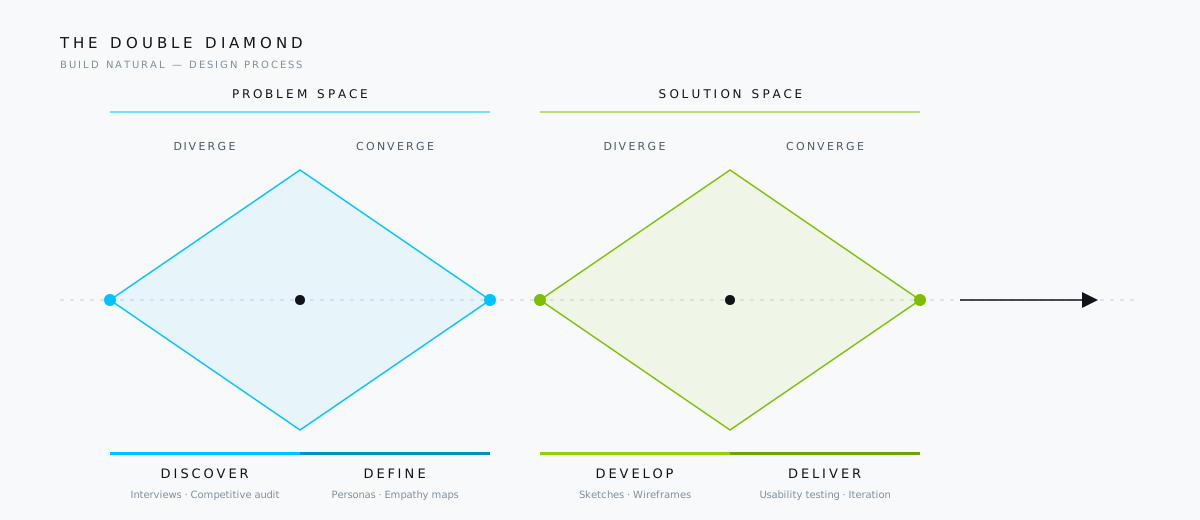 Double Diamond Processimages/double-diamond.svg
Before proposing anything, we mapped every channel through which natural-building knowledge currently travels, scoring each on fidelity and on access barrier.
The category split cleanly along a single line. Channels with reach — video, social, books — carried no credentialing and no local context. Channels with depth — schools and mentorship — were scarce, costly, and effectively network-gated.
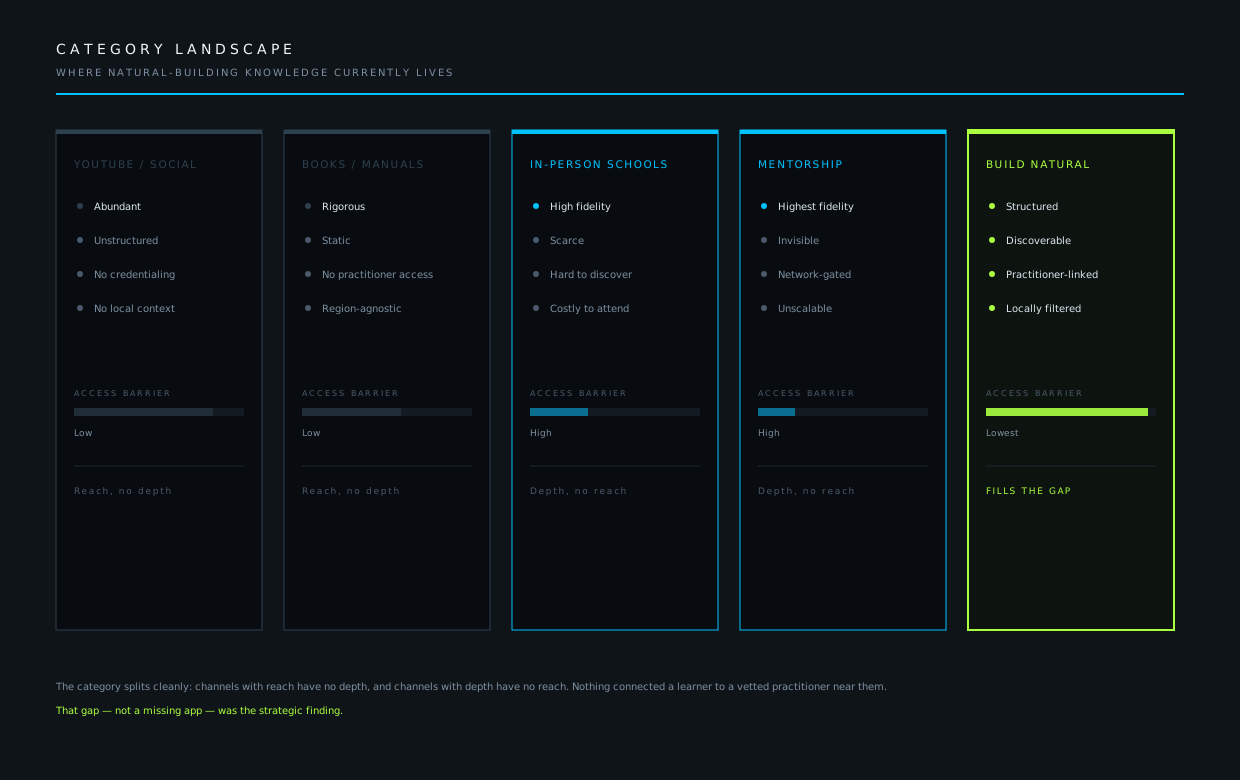 Category Landscapeimages/bn-landscape.svg
We interviewed people actively working in natural building and traced the path each had taken to get there. Every one of them had self-taught over years. Not one could describe a structured route — because none existed to describe.
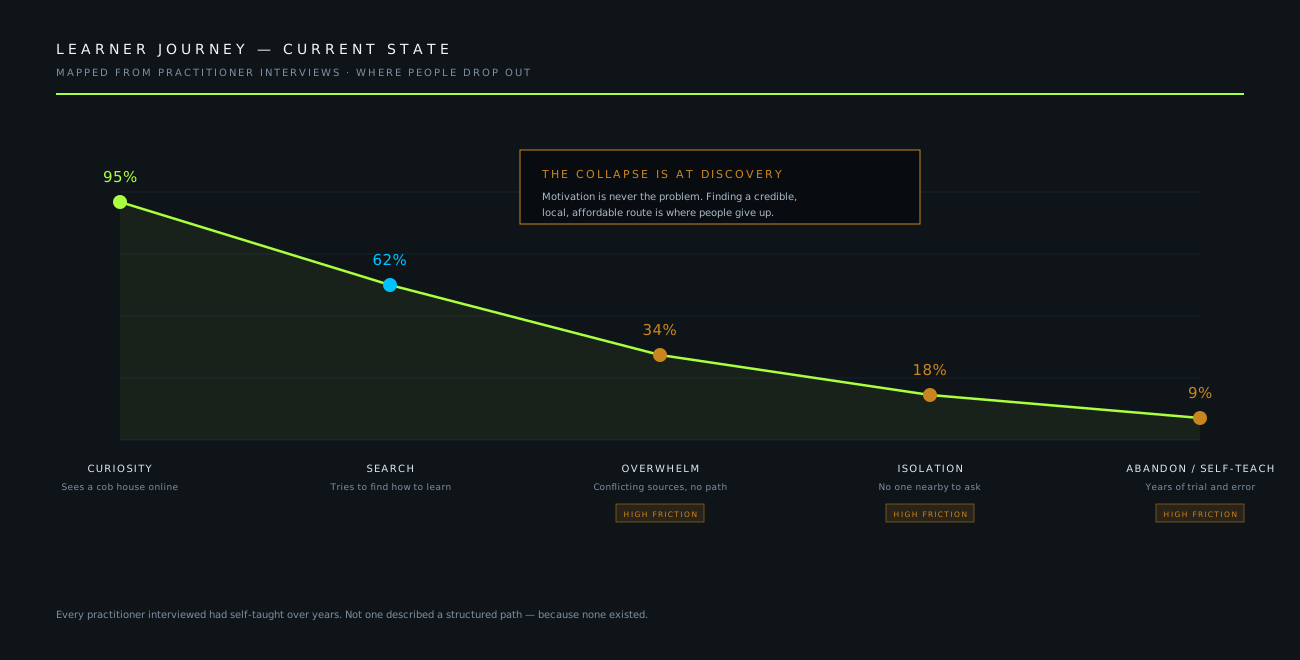 Learner Journeyimages/bn-journey.svg
Personas were assembled from interview evidence rather than invented — each traces to a distinct motivation and a distinct blocker.
 Persona — Lucasimages/persona-lucas.jpg
 Persona — Pascalimages/persona-pascal.jpg
 Persona — Sofiaimages/persona-sofia.jpg
Participants could find a hundred videos in a minute. What they could not establish was which source to trust, which technique suited their climate, and who nearby had actually built something that stood up.
Every practitioner interviewed expressed willingness to mentor. None had a mechanism for being found. Supply and demand both existed; the market simply had no clearing layer.
Natural building is governed by soil, climate, and local code. A technique that works in Oregon may be unbuildable in Arizona. Any product that treats geography as an optional filter is giving wrong answers.
The evidence pointed away from the obvious build. A content library would have competed with YouTube on YouTube's terms and lost. The defensible position was the one nobody occupied: structured discovery of credentialed, local, human instruction.
That reframing changed the information architecture entirely. Materials became a navigational spine rather than a content destination — the thing you browse in order to find the right school or mentor, not the thing you consume.
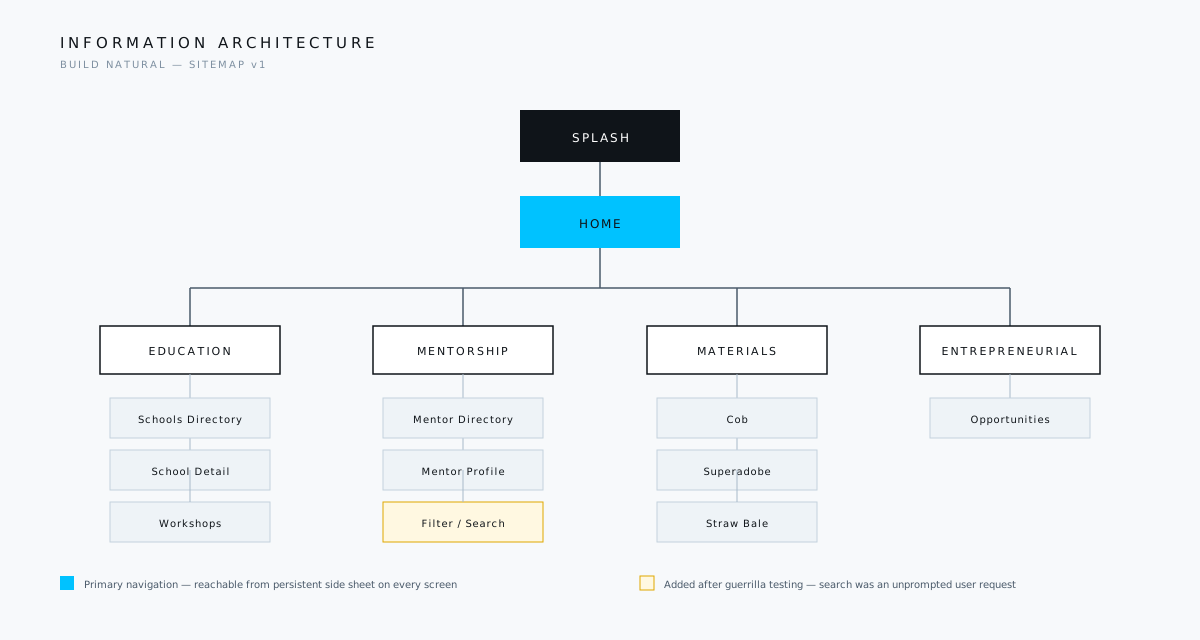 Sitemapimages/sitemap.svg
Walk the red route that testing prioritised: from not knowing the vocabulary to booking time with a practitioner. Each screen pairs with the finding that shaped it.
The flow opens with geography, not content. Where you are building determines what you can build.
Locality emerged as a hard constraint. Showing a technique that cannot be permitted or survive the climate is worse than showing nothing.
Paper prototypes were tested before any high-fidelity work began. Three scenarios, each mapping to a red route identified in research.
"Locate a school that will teach you to build with cob or superadobe."
"You've found the school but don't actually know what cob is. Find out."
"No school fits your budget. Could you find a person to show you instead?"
Inconsistent navigation broke the user's mental model. Present on every screen or present on none.
An IA misplacement that caused repeated disorientation during testing. Relocated before build.
Unprompted and repeated across sessions. Added to the architecture on the strength of testing alone.
 Splashimages/hifi-splash.png
 Homeimages/hifi-home.png
 Educationimages/hifi-education.pngMentorshipimages/hifi-mentorship.png