A Latino-founded savings platform was being pushed to abandon the thing that made it different. Research showed that thing was the entire moat.
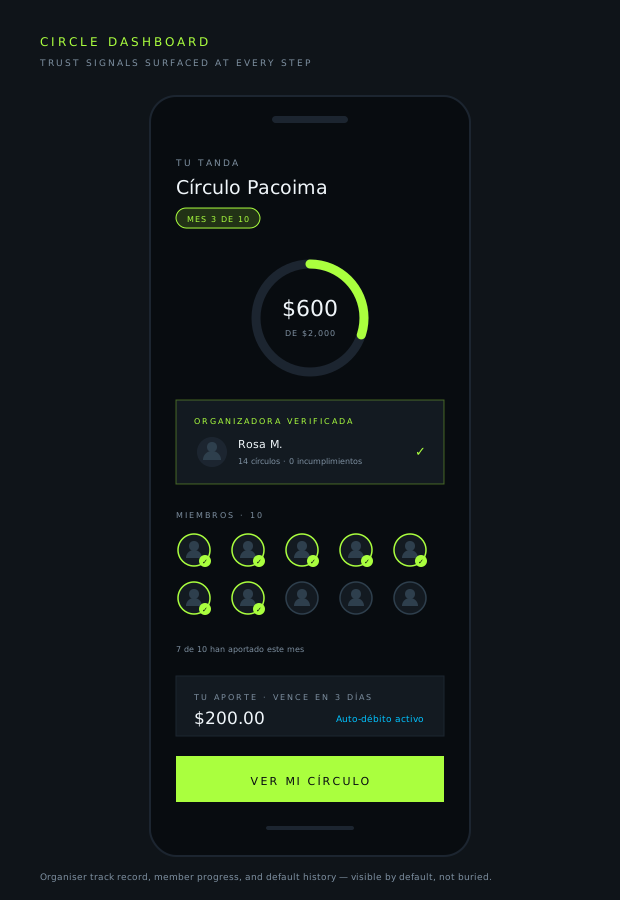
Semilla digitised the tanda — the rotating savings circle that millions of Latino households already use to access capital without credit checks, interest, or a bank. Two Mexican-American founders built it because they'd grown up inside one.
Eighteen months in, growth had plateaued. Their investors drew the obvious conclusion: the cultural specificity was limiting the market. The recommendation was to pivot toward a general-purpose neobank and treat the tanda as a legacy feature.
The founders disagreed but couldn't prove it. They brought us in to settle the question with evidence rather than conviction — nine weeks to decide the company's direction.
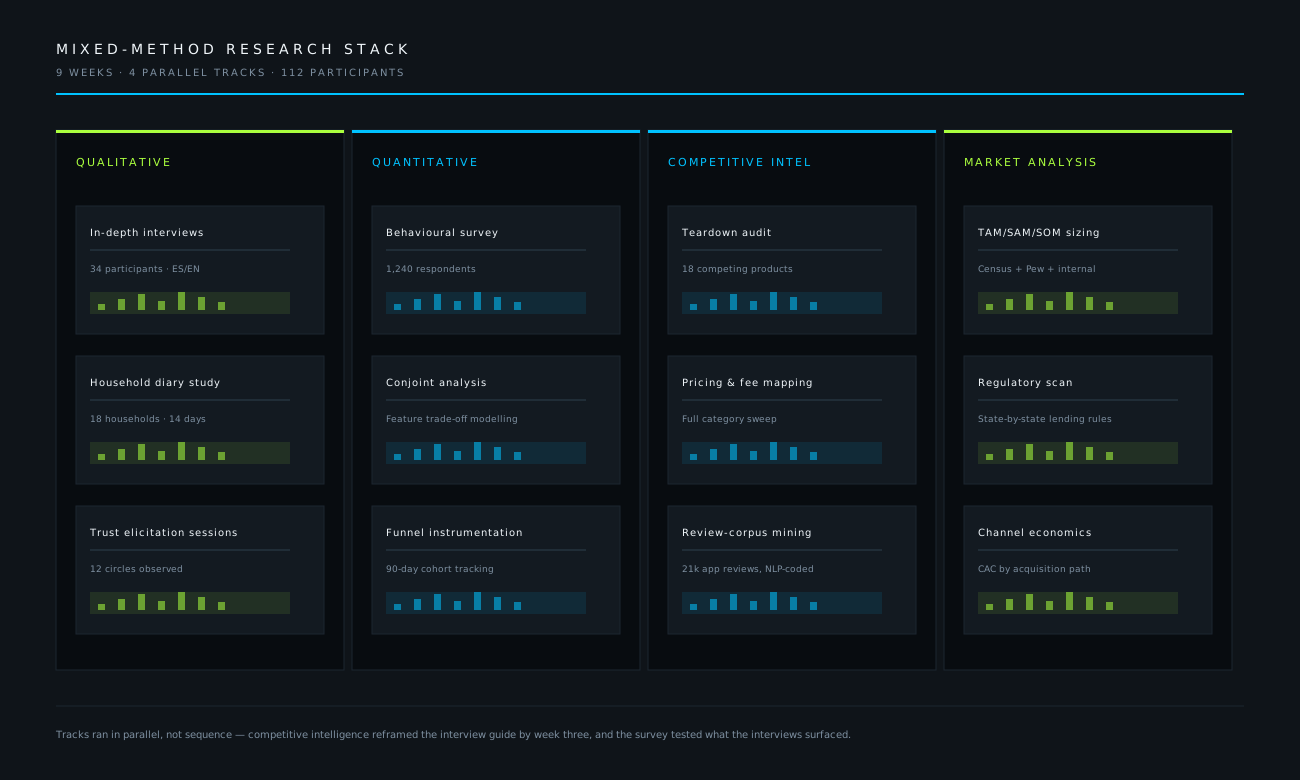
A question this consequential couldn't be answered by interviews alone. We ran qualitative, quantitative, competitive, and market workstreams simultaneously so each could redirect the others mid-flight.
Stakeholder and investor interviews to surface the assumptions behind the proposed pivot, stated explicitly enough to be tested.
Four parallel research tracks — in-depth qualitative, behavioural survey, competitive teardown, and market sizing.
Findings mapped against the pivot thesis. Where evidence contradicted it, we quantified the cost of being wrong.
A revised strategy, a reordered roadmap, and the trust architecture needed to make the existing model scale.
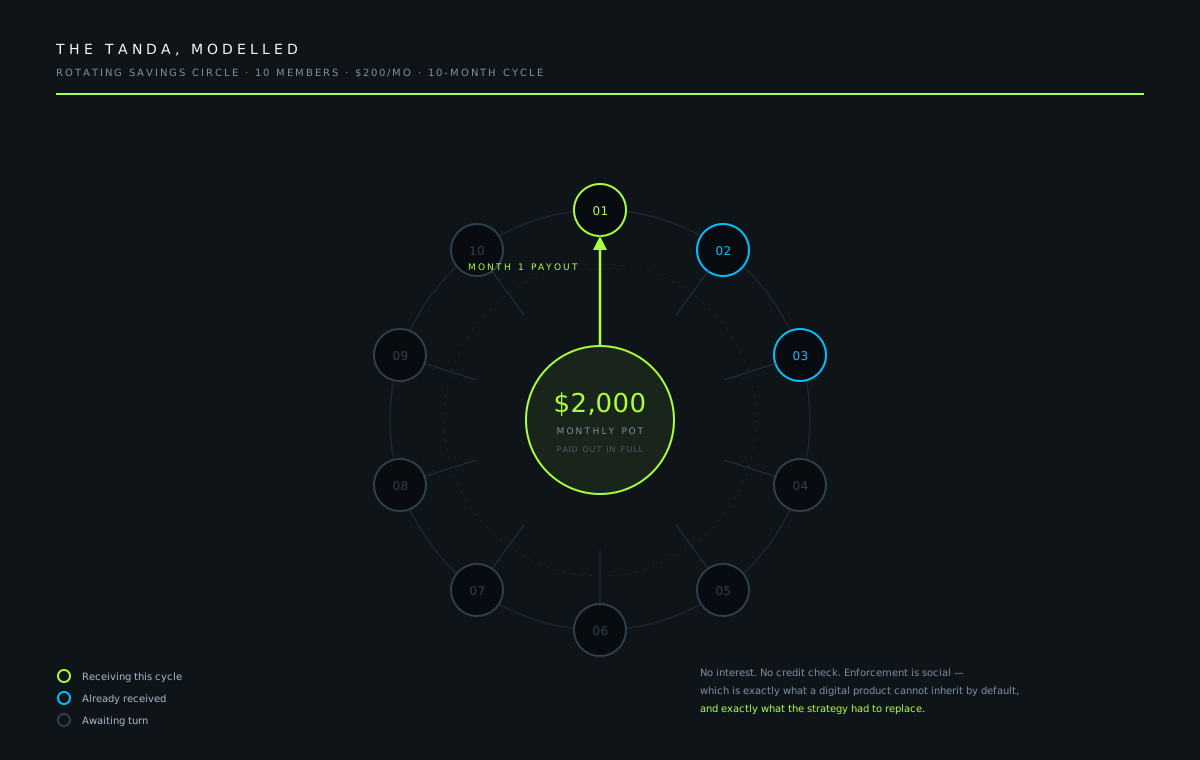
Before we could evaluate the product, we had to model the behaviour it was digitising. A tanda is ten people contributing a fixed amount monthly; each month one member takes the full pot. No interest. No credit check. No institution.
It functions because default is socially unthinkable — you know everyone in the circle, and your standing in a community is the collateral. That's an enforcement mechanism no app inherits by default.
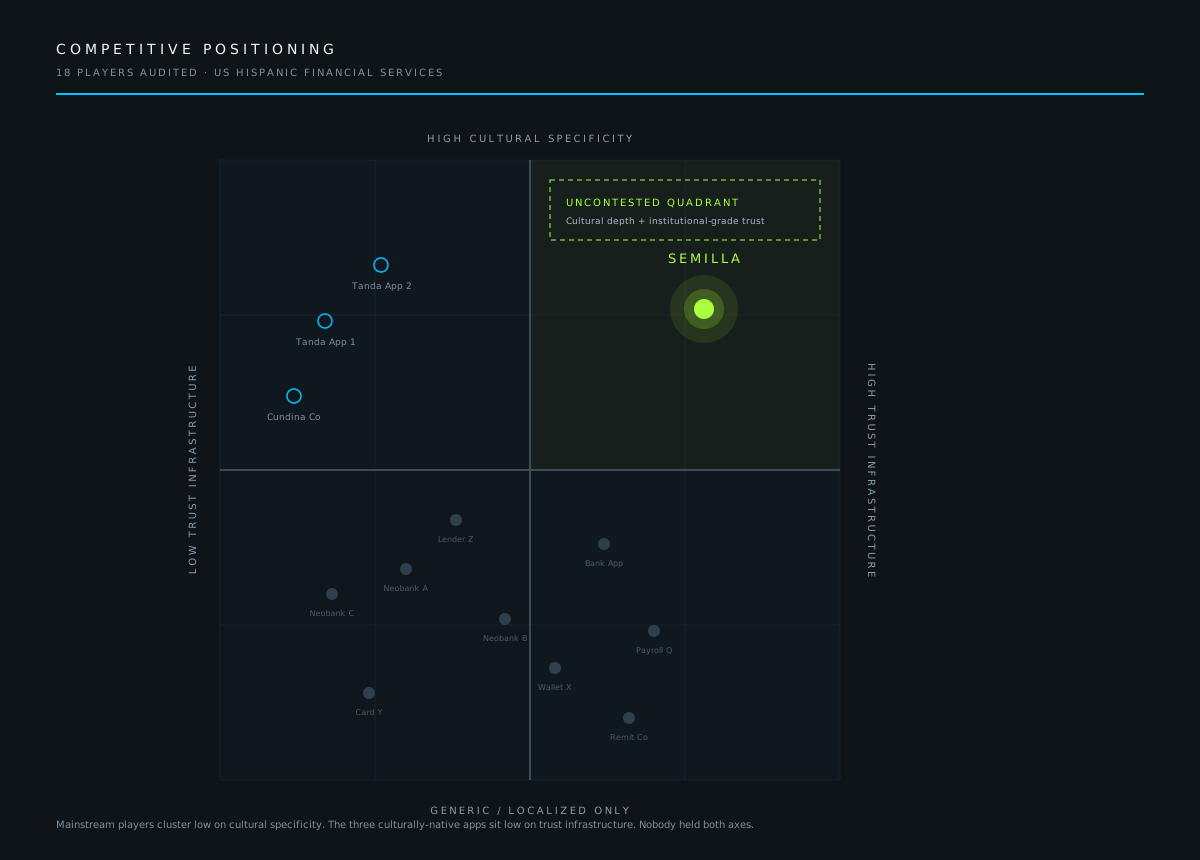
We audited every product competing for the same wallet — mainstream neobanks, remittance services, payroll-advance apps, and the handful of tanda-specific tools. Teardowns, fee structures, onboarding flows, and 21,000 app-store reviews coded for recurring complaint themes.
Plotted against cultural specificity and trust infrastructure, the category sorted itself cleanly: mainstream products had institutional trust but no cultural depth. The culturally-native apps had the opposite problem — they understood the tanda but couldn't make strangers trust one.
Conjoint analysis put Semilla's culturally-native features as the single strongest driver of consideration — ahead of fees, speed, and brand. Stripped of them, the product tested as the weakest entrant in a category with nine better-funded incumbents.
It was blocked by trust between strangers. Existing users recruited only from their own networks, which capped each circle at the founder's social graph. The ceiling was structural, not demographic.
Investor sizing counted only unbanked Hispanic households. Our analysis showed the majority of active tanda participants were fully banked and using circles by preference — roughly tripling the addressable market.
Treat the tanda as a niche onboarding hook, de-emphasise the cultural framing, and compete as a general-purpose neobank for Hispanic consumers.
Keep the cultural model exactly as it is and build the missing layer underneath it — the trust infrastructure that lets a circle form between people who don't already know each other.
If social enforcement was what made the offline tanda work, the product had to replace it mechanism by mechanism — not approximate it with generic fintech patterns.
We mapped every source of offline trust to a product equivalent, then sequenced them by how much each contributed to circle completion in the behavioural data. Three of nine planned features accounted for most of the effect. The roadmap was cut accordingly.
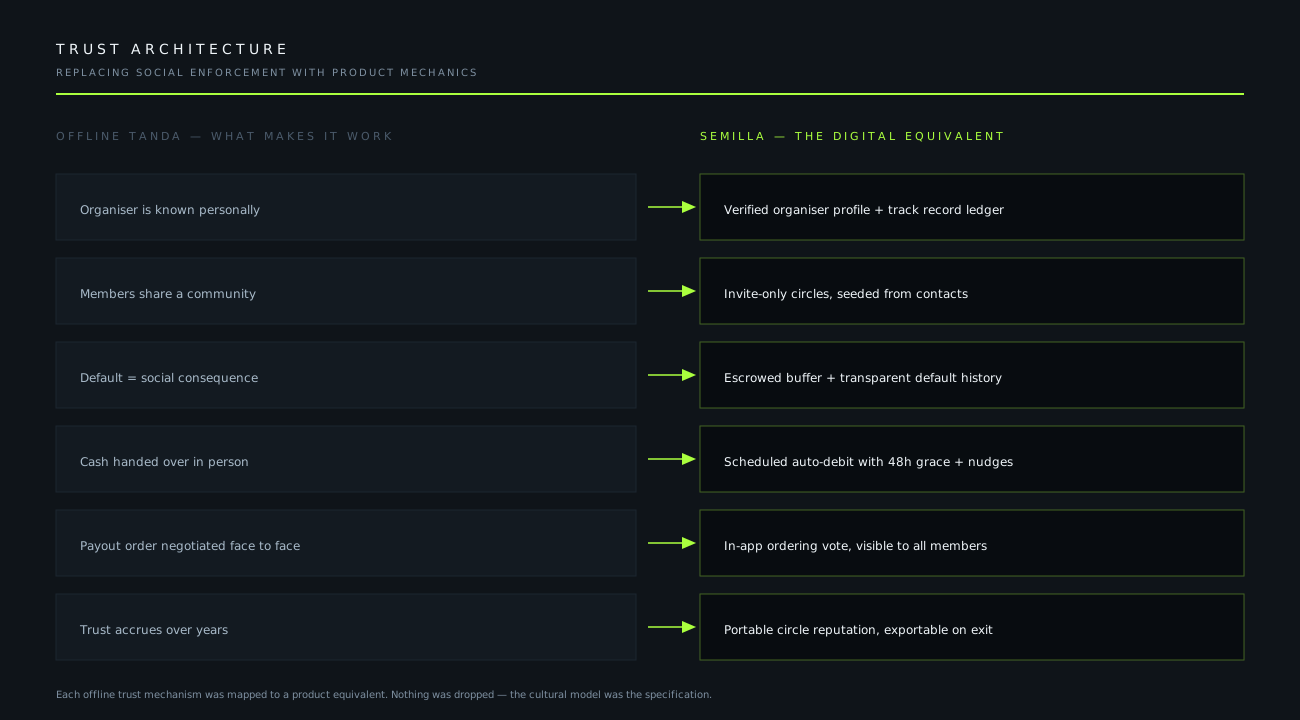
Trust had to be established before a single dollar moved. Step through the onboarding sequence we tested — each screen pairs with the research finding that put it there.
A circle is never discovered — it's inherited. Entry always begins with a named person who already carries standing.
Zero participants said they would join a circle of strangers. Every single one had joined through someone they knew.
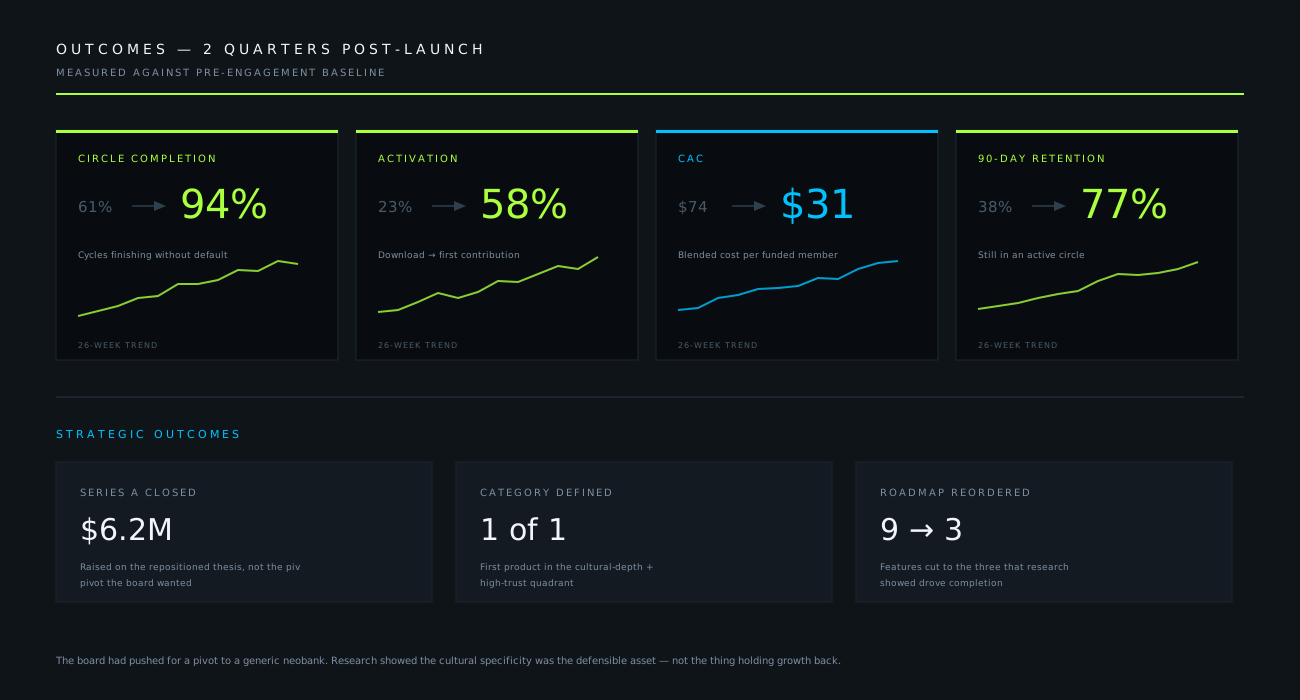
The company did not pivot. It raised its Series A on the strategy the research produced — the opposite of the one it walked in planning to pursue.
This is the kind of question UX strategy exists to answer. Not which button to move — whether the company is pointed at the right market at all, and whether the thing it's being advised to abandon is actually the thing worth defending.